Nobody Owns the Night: In Defense of Showing Up Without a Booking
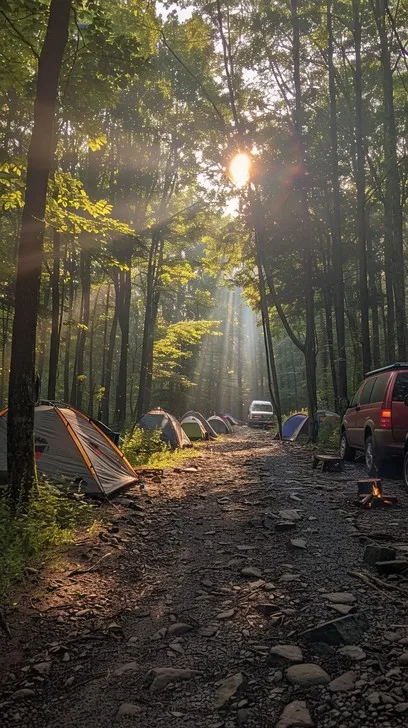
Photo: empty first-come first-served forest campground with open campsites morning light, via images.stockcake.com
Here's a sentence I never thought I'd write about camping: I checked a reservation window, set an alarm, and competed with several thousand strangers for a campsite.
This is normal now. Recreation.gov releases inventory at 10 a.m. Eastern, six months out, and popular campgrounds — Yosemite's valley floor, Montana's Fishing Bridge, the walk-in sites at Joshua Tree — evaporate in minutes. Third-party bots scrape the inventory. Cancellation-hunting services sell subscriptions. We have, with the best intentions, built a system where camping in America's most beautiful places requires the same energy as getting Taylor Swift tickets.
I don't think this is fine, actually.
The Fifteen Campgrounds Problem
The scramble has a side effect nobody talks about: it funnels everyone into the same handful of famous destinations. When your trip planning starts with "what can I book," you end up at the places with the most articles written about them, photographed from the same three overlooks. The campground two valleys over — first-come, first-served, half empty in October — doesn't exist to you, because it never showed up in your search.
Camping was supposed to be the cheap, flexible, anyone-can-do-it option. When the entry point is a timed online scramble, it quietly selects for people with flexible work schedules, fast internet, and the leisure to plan six months out. That's not the outdoors. That's just another queue.
What First-Come, First-Served Actually Offers
A huge share of American public land — Forest Service campgrounds, BLM land, most of the dispersed camping network — doesn't take reservations at all. You drive up, you pick a site, you pay twelve dollars in cash or nothing at all. The uncertainty is real, but so is the freedom: you can leave early if it rains, stay an extra night if it's perfect, and change your whole route on a whim because a ranger mentioned a lake.
Some of my best trips started with no itinerary. The worst one that started that way ended with a Walmart parking lot in Nevada — so no, this isn't a fairy tale. But the failure mode of a spontaneous trip is a motel room. The failure mode of a rigid, booked-six-months-out trip is going anyway, in a wildfire smoke event, because you paid and you're committed.
A Simple Framework: Book or Drive?
I'm not advocating chaos. Here's the decision tree we actually use:
Book ahead when: you're tied to specific dates (a wedding, a holiday weekend), you're bringing people who can't sleep in a car if things go sideways, or the destination genuinely has no alternative inventory — certain national park campgrounds are simply singular. Also book if it's your first trip and certainty lowers your stress. That's a legitimate reason.
Just drive when: you have flexibility on location, you're traveling in shoulder season (May–early June, September–October in most of the country), or you're comfortable with dispersed camping as a fallback. National forests alone contain thousands of free, legal spots. Apps and Motor Vehicle Use Maps make them findable.
Split the difference when: you book the first night only, then wing it. This is the move. You get a guaranteed landing after a long drive and total freedom after that.
The Season Nobody Wants
One more heresy: go in the off weeks. June in the Sierra, October in the Ozarks, late September in the Adirondacks — the weather is often better than peak season, the bugs are down, and the first-come campgrounds sit half empty. The reservation frenzy exists partly because everyone wants the same two weeks in July. Shoulder season is the cheat code hiding in plain sight, and your calendar, not a booking algorithm, is the only thing keeping you from it.
None of this means reservations are evil. It means we've let one strategy — plan far, book early, compete hard — become the only story. The public lands belong to whoever shows up. Sometimes the best site is the one you didn't know you were getting.